

At first I thought, how can a gummy help with weight loss? It’s a sweet! But it actually works the opposite way — I feel fuller, snack less, and it’s made sticking to my weight loss goals much easier.

On a GLP-1, you eat less of everything - and fiber goes first. Two gummies before a meal. 4 g of real fruit fiber. Zero sugar, zero sugar alcohol.

GLP-1 medications slow how fast your stomach empties. That's part of how they keep you full, and it's also why things back up.
Kiwi is our first ingredient, 600 mg of whole fruit. In an international trial it matched psyllium — the fiber in Metamucil — with significantly fewer GI symptoms.⁷ Two gummies, 4 g of fiber, things moving.*"

Fiber lives in the bulkiest things on your plate. The vegetables, the fruit, the whole grains. Those are the first to go when you can't finish a meal.
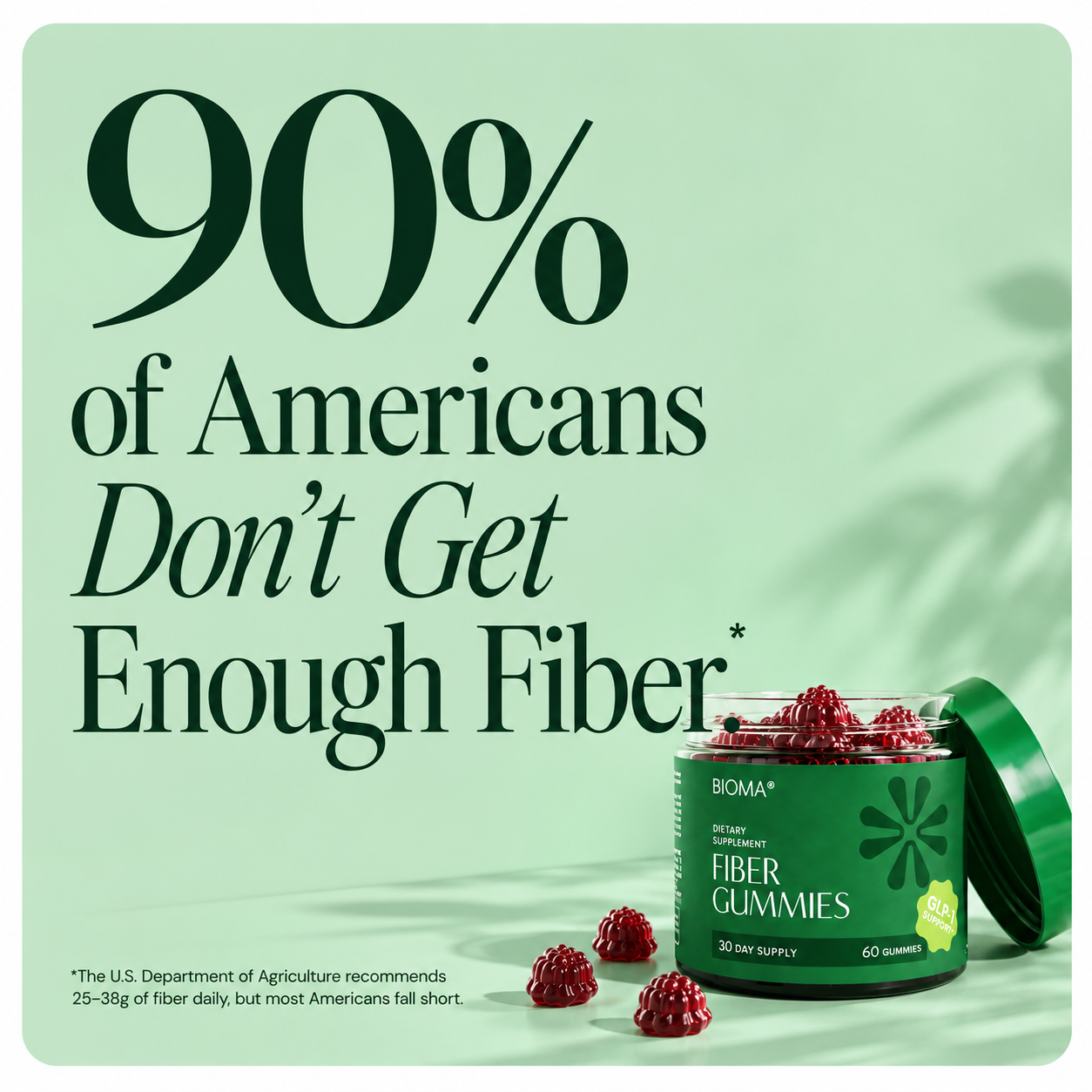
You still need 25 to 38 grams a day.² Adults with a full appetite average 12 to 14.³ Eating less doesn't move the target. It just takes away the room you had to hit it.

Ask anyone on a GLP-1 what they want less of. Pills and powders.
A full glass of gritty psyllium is a lot to ask when half a sandwich is a challenge. Two gummies before a meal. Ten calories. Nothing to mix, nothing to swallow, nothing to rinse out.

Tried a fiber supplement on a GLP-1 and ended up tighter instead of better? That wasn't your imagination. Fermentation makes gas, and gas has nowhere to go when digestion is already slow.
So we built the antidote in. Ginger supports how fast your stomach empties.⁵ Lemon balm calms cramping.⁶ Fiber, and you still feel light.*

On a small appetite, every calorie should earn its place. Most gummy supplements carry two to four grams of sugar. The sugar-free ones swap in sugar alcohols, which is close to the last thing a slow gut needs.
Ours: 0 g sugar, 0 g sugar alcohol, 4 g fiber, 10 calories. It's the sweet thing you have instead of the sweet thing.

Most people don't stay on a GLP-1 forever. Appetite comes back.
Fiber triggers your body's own GLP-1 — same hormone, made by you. In a placebo-controlled trial, adults given prebiotic fiber showed higher GLP-1 and felt less hungry.⁴ Two gummies before a meal is a good habit on the medication. It's worth more after.*
Bioma Fiber Gummies are a sugar-free blend of whole-fruit fiber, prebiotics and two soothing botanicals. They keep you regular, ease the bloating fiber usually causes, and support your body's own GLP-1.* Two gummies before a meal, and they taste like a treat.


Bioma Fiber Gummies are a sugar-free blend of whole-fruit fiber, prebiotics and two soothing botanicals. They keep you regular, ease the bloating fiber usually causes, and support your body's own GLP-1.* Two gummies before a meal, and they taste like a treat.
 Vegan
Vegan
 Non-GMO
 Gluten-Free
 Soy-Free
 Keto-Friendly
 Stimulant-Free
 0 g Sugar
 Whole-Fruit Fiber
Couldn't load pickup availability
Cancel Anytime. Free Shipping. Guaranteed Safe Checkout


 Loved by Customers Nationwide




Overall rating: 4.8 / 5 from 3553 reviews.
At first I thought, how can a gummy help with weight loss? It’s a sweet! But it actually works the opposite way — I feel fuller, snack less, and it’s made sticking to my weight loss goals much easier.

Happy!!! Really easy way to get my daily fiber. They taste great, help with digestion and bloating, and have become part of my everyday routine.

Love it! The easiest way to get my daily fiber in.

Real talk: regular as clockwork and no discomfort at all and 5 stars from me

Decent, might need longer to really tell

fits into my morning routine without any effort

Feeling great honestly

Two gummies a day and my fiber is covered

More energy than I've had in months honestly. would be perfect with a bigger bottle

I feel lighter and way more energized during the day, my whole routine feels easier

Way less bloated after meals since starting these. tell everyone about these
My favorite guilt-free snack... and it actually counts toward my daily fiber
Finally! A snack thats actually healthy and helps me get my fiber in
the easiest way i get my daily fiber
Wish I'd found these sooner honestly and the taste is a bonus
At 45 my gut needed help and tastes like candy but sugar free, total win
Didn't expect much but I genuinely enjoy taking these, flavor is lovely, wish I started sooner
my cravings for sweets have calmed way down and impressed honestly
And they actually taste good, not like medicine, impressed honestly
Average so far, giving it ANOTHER month
Postpartum my digestion was a mess and so much easier than tracking fiber in my food
At 45 my gut needed help and and they actually taste good, not like medicine, impressed honestly
not gonna lie, finally regular again after years of being all over the place, wish i started sooner
bought these on a whim and best supplement i've added to my routine in ages
Ok so the taste is great and no sugar which I love
The fullness lasts and I eat less at dinner
Update: the taste is great and no sugar which I love and big difference for me
Way better than the gritty fiber drinks I forced down before. can't go back now
Ok so more energy in the afternoons, no more 3pm slump, the taste is a bonus
Skeptical at FIRST but my gut has honestly never felt this good and can't go back now
ngl tastes like candy but sugar free, total win and will reorder for sure 👏
These are a non negotiable part of my day now and 5 stars from me
At 45 my gut needed help and so glad I gave these a try
tmi but easiest way to get my fiber without choking down powders
game changer for my gut
My gut feels settled, not gassy and uncomfortable and can't go back now
sugar free but they taste like a treat, highly recommend
These calmed my bloating within the first week
Honestly, more energy in the afternoons, no more 3pm slump and buying again
steady energy all day with no crash 👏
Plenty of people add fiber while they're on one. These are food-based — fruit powders, a prebiotic fiber base, two botanicals, no stimulants. Anything you add alongside a prescription is still a conversation for your prescriber, including timing. Have it.
That's a question for whoever wrote your prescription, and we'd rather you ask them than take our word for it. What's in the jar: whole-fruit fiber, short-chain FOS, ginger, lemon balm. A food-based supplement, not a drug, and it doesn't act on the same receptor your medication does.
No. A medication delivers a synthetic version of GLP-1 at a pharmaceutical dose. Fiber supports the GLP-1 your own body releases, from food.* Different things, and we won't pretend otherwise. Don't change a prescription based on a supplement page.
No, and we won't dress them up as one. They're a fiber supplement. What fiber does is keep you regular and make eating less feel less like a fight.* Exercise and a healthy diet are still what move the scale.
That's the botanicals' job. Ginger supports motility so you don't feel like a brick, and ginger plus lemon balm ease the gas and tightness that come with more fiber.* Matters more on a GLP-1, where things are already slow.
0 g sugar, 0 g sugar alcohol, 4 g fiber, 10 calories, 2 g net carbs. Sweetened with allulose — not sugar, not the sugar alcohols behind most sugar-free gummy complaints. Keto-friendly. Managing glucose alongside a prescription? Run the label past your prescriber.
Smoother digestion and less bloat inside the first couple of weeks for most people. Give it 60 to 90 days for the full picture. Results vary.*
Different pathway. The Booster works through your gut microbiome. These work through fiber, polyphenols and plant compounds from food. They don't compete — plenty of people take both. Starting with one? Start with fiber. It's the gap more than 9 in 10 adults have.¹
Nope, exclusively here. Fresh, authentic product, best bundle pricing and guarantee, every jar traceable to us.
Quagliani D, Felt-Gunderson P. "Closing America's Fiber Intake Gap." American Journal of Lifestyle Medicine, 2016 — approximately 95% of American adults fall short of recommended fiber intake.
U.S. Department of Agriculture and U.S. Department of Health and Human Services. Dietary Guidelines for Americans, 2020–2025 — recommended adult dietary fiber intake of 25 to 38 grams per day.
Thompson HJ, Brick MA. "Perspective: Closing the Dietary Fiber Gap." Advances in Nutrition, 2016 — US median dietary fiber intake of 12 to 14 grams per day.
Cani PD, Lecourt E, Dewulf EM, et al. "Gut microbiota fermentation of prebiotics increases satietogenic and incretin gut peptide production." American Journal of Clinical Nutrition, 2009;90(5):1236–43 — randomized, double-blind, placebo-controlled; prebiotic supplementation increased plasma GLP-1 and PYY and lowered hunger rates.
Wu KL, Rayner CK, Chuah SK, et al. "Effects of ginger on gastric emptying and motility in healthy humans." European Journal of Gastroenterology & Hepatology, 2008;20(5):436–40 — randomized double-blind crossover (n=24); ginger accelerated gastric emptying.
Aubert P, Guinobert I, Blondeau C, et al. "Basal and Spasmolytic Effects of a Hydroethanolic Leaf Extract of Melissa officinalis L. on Intestinal Motility." Journal of Medicinal Food, 2019 — dose-dependent spasmolytic activity on intestinal tissue, ex vivo.
Gearry R, Fukudo S, Barbara G, et al. "Consumption of 2 Green Kiwifruits Daily Improves Constipation and Abdominal Comfort." American Journal of Gastroenterology, 2023 — n=184 across 3 countries; no significant weekly difference versus psyllium, and significantly greater reduction in GI symptoms than psyllium.
Salmean YA. "Acute fiber supplementation with inulin-type fructans curbs appetite sensations." Food & Nutrition Research, 2017 — randomized double-blind placebo-controlled (n=40); increased fullness and approximately 21% lower caloric intake at lunch.

© 2026 Bioma Health. All rights reserved.
Disclaimer: Content and statements on this website have not been evaluated by the Food and Drug Administration. This product is not intended to diagnose, treat, cure, or prevent any disease. It should not be substituted for medical advice or medical intervention. Please consult a qualified healthcare provider when making medical decisions. Exercise and a healthy diet are necessary to achieve and maintain weight loss.